

Some links below may be affiliate links. I only recommend products I personally use and stand behind.
Dryer sheets feel harmless because they’re familiar.
They’ve been sold for decades as a quick way to make laundry feel softer, smell better, and cling less. Procter & Gamble introduced Bounce in 1973, right as home dryers became widespread, specifically to solve static cling and stiffness caused by machine drying.
And they worked.
But more people are starting to ask a better question:
What do dryer sheets actually do to your clothes, and are there better non-toxic dryer sheet alternatives?
Because here’s what’s rarely explained clearly:
Dryer sheets do not improve fabric by cleaning it.
They improve the feel of fabric by depositing a coating onto it.
Fabric softening agents are intentionally designed to:
• reduce static
• reduce friction
• smooth texture
• carry fragrance
That difference matters.
Because once you understand that “softness” is often coming from a residue layer rather than the fabric itself, a lot of common frustrations start to make sense:
• towels that stop absorbing properly
• activewear that doesn’t perform the same
• clothes that smell strong but don’t actually feel cleaner
What Dryer Sheets Are Made Of
A dryer sheet is not just paper.
Physically, it is a nonwoven material, typically made from synthetic fibers like polyester or polypropylene, engineered to:
• withstand heat
• carry a chemical coating
• release that coating evenly during tumbling
The sheet itself isn’t softening your clothes.
It’s acting as a delivery system.
Dryer Sheet Chemicals: What’s Actually in Them
The coating is where everything happens.
Dryer sheet chemicals are designed around three outcomes:
• soften
• control static
• add scent
To do that, they commonly use:
• quaternary ammonium compounds (quats)
• fragrance mixtures (often undisclosed)
• fatty acids or lubricating agents
Quats are key.
They carry a positive charge, allowing them to bind to negatively charged fabric fibers. This neutralizes static and creates that smooth, conditioned feel.
Common ingredient names include:
• distearyldimonium chloride
• dialkyldimethyl ammonium chloride
• cetrimonium chloride
These are designed to:
• stick to fabric
• remain after drying
• build up over time
Which is why dryer sheet chemicals don’t just disappear after one cycle.
How Dryer Sheets Work in the Dryer
The mechanism is simple:
heat activates
movement distributes
fabric retains
As your dryer runs:
• the coating softens
• spreads across fabrics
• bonds to fibers
This creates a thin, invisible layer on your clothes.
That layer is what:
• reduces static cling
• creates softness
• holds fragrance
This is why dryer sheets feel effective immediately.
But it’s also why the effect doesn’t wash away easily.
Fabric Softener Buildup: The Hidden Tradeoff
Dryer sheets don’t change fabric internally.
They change the surface of fabric.
And over time, that creates what’s known as:
Fabric softener buildup
This shows up in ways people already notice:
• towels feel soft but stop absorbing water
• activewear traps odor instead of releasing it
• microfiber loses its ability to clean properly
Because when you repeatedly coat fibers:
• absorbency decreases
• breathability changes
• performance declines
So yes, dryer sheets “work.”
But the better question is:
Are they improving your laundry, or just coating it?
What “Fragrance” Means in Laundry Products
On the label, you’ll usually see:
Fragrance
But that single word can represent dozens to hundreds of chemicals.
Companies are not required to fully disclose these mixtures.
So you’re applying a combination of compounds you can’t fully identify to your clothes, repeatedly.
Common fragrance-related compounds include:
• limonene
• linalool
• benzyl acetate
• hexyl cinnamal
The issue isn’t one ingredient.
It’s repeated exposure, combined with heat.
Heat + Fragrance: What Changes in the Dryer
A dryer creates the exact conditions that increase chemical activity:
• heat
• airflow
• oxygen
Under these conditions, certain compounds can oxidize, forming new byproducts.
These byproducts are more likely to:
• trigger irritation
• act as sensitizers
• affect the respiratory system in sensitive individuals
So it’s not just:
What’s in the product
It’s also:
What those ingredients become during the drying process
Dryer Vent Emissions: What Gets Released Into the Air
This is where it becomes measurable.
Studies analyzing dryer exhaust have detected 25+ volatile organic compounds (VOCs) released when fragranced laundry products are used.
These include:
• acetaldehyde
• ethanol
• limonene
During a single cycle:
• some compounds stay on clothing
• some remain in indoor air
• some are released through the dryer vent
That’s why you can smell laundry outside.
That scent is part of what’s being emitted into the surrounding environment.
Why Dryer Sheets Affect Skin and Clothing Performance
Clothing is constant contact.
Your skin interacts with your clothes all day.
Your towels touch damp skin.
Your activewear sits against heat and sweat.
When a coating is present, that exposure becomes continuous.
For some people, this can contribute to:
• irritation
• sensitivity
• flare-ups of existing skin conditions
Even without visible reactions, function changes:
• towels lose absorbency
• fabrics lose breathability
• moisture-wicking decreases
This is where people start asking:
Are dryer sheets actually helping long-term?
The Environmental Impact of Dryer Sheets
Most people stop at:
“They’re single-use”
But the impact goes deeper.
Single-Use Waste
Dryer sheets are used once and discarded.
Most are made from synthetic fibers that don’t break down easily.
Persistent Chemical Residue
Quats are designed to bind and persist.
That also means they don’t break down quickly in water systems.
Fragrance compounds are used repeatedly, contributing to cumulative exposure.
Air Emissions
During drying, not all compounds stay on fabric.
Some are released through the dryer vent.
So laundry becomes part of the surrounding air environment.
This is not about one load.
It’s about repeated exposure at scale.
Why People Are Switching to Non-Toxic Dryer Sheet Alternatives
More people are rethinking dryer sheets because of:
• fabric buildup
• reduced performance
• repeated exposure
• unnecessary waste
And once you understand how dryer sheets work, switching becomes straightforward.
Best Non-Toxic Dryer Sheet Alternatives That Actually Work
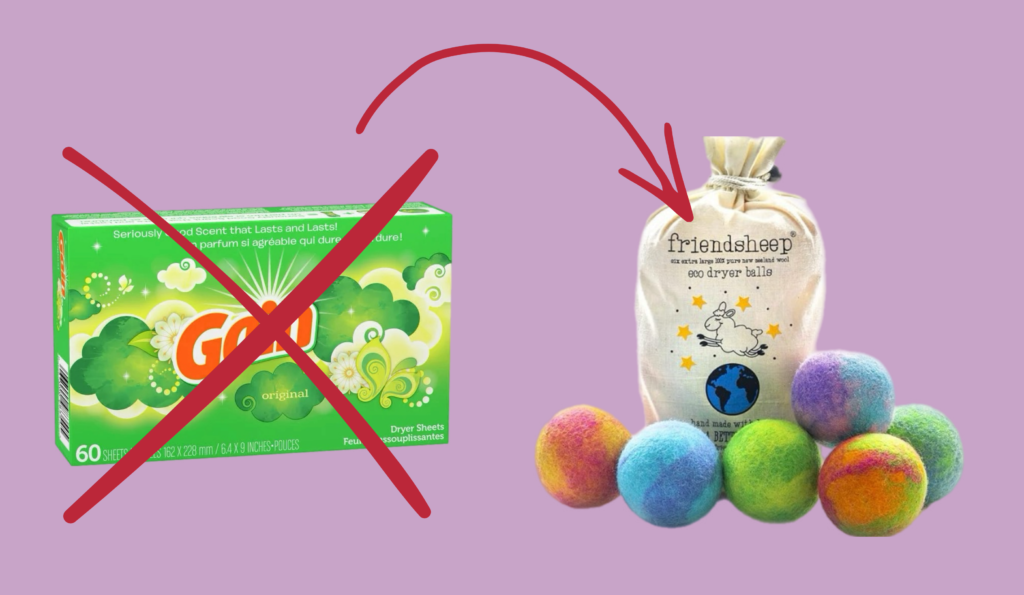
Wool Dryer Balls vs Dryer Sheets
Wool dryer balls work differently.
They don’t coat fabric.
They improve the drying process itself.
By:
• separating fabrics
• increasing airflow
• reducing drying time
Which naturally reduces static.
Wool Dryer Balls (Best Everyday Swap)
• reduce static naturally
• improve airflow
• shorten drying time
• do not coat fabric
Recommended options:
→ Friendheep Wool Dryer Balls
→ Molly’s Suds Wool Dryer Balls
→ Budieggs Wool Dryer Balls
→ Ezhippie Wool Dryer Balls
→ Softkomfy Wool Dryer Balls
→ Dirty Labs Wool Dryer Balls
→ Nervana Wool Dryer Balls
Distilled White Vinegar (Buildup Removal + Softening)
Add about ½ cup to the rinse cycle.
It:
• breaks down detergent residue
• softens fabric naturally
• restores absorbency
Options:
→ 365 Organic White Vinegar
→ Aunt Fannie’s Extra Strength Vinegar
→ Mother Earth Vinegar
→ De La Rosa Distilled White Vinegar
How to Make Laundry Smell Good Naturally
This is usually the biggest hesitation.
Because it’s not really about dryer sheets.
It’s about scent.
Better approaches:
• essential oils on dryer balls
• switching to cleaner detergents
• allowing fabric to smell neutral
Clean doesn’t need artificial fragrance.
The Bottom Line on Dryer Sheets
Dryer sheets are NOT necessary.
They work by adding a layer of:
• softening agents
• fragrance
• coating that stays on fabric
There are simpler ways to get the same results without relying on that process.
Dryer sheets don’t clean your clothes.
They condition you to associate coating with clean.
FAQ: Dryer Sheets vs Alternatives
Are dryer sheets bad for you?
They can contribute to buildup on fabrics and exposure to fragrance compounds, especially with repeated use.
Do dryer sheets ruin towels?
They can reduce absorbency over time due to coating.
Are dryer sheets bad for activewear?
They can interfere with moisture-wicking performance.
Do wool dryer balls work as well?
They work differently, but avoid coating and are reusable.
Want My Favorite Swaps?
→ Find them here, or comment SWAPS on my Non-Toxic Dryer Sheet Swaps Instagram post and I’ll send everything directly.
If you want to go deeper, here’s the research behind everything:
Sources & Research
Steinemann, A. (2011). Fragranced consumer products: emissions and exposures from dryer vents.
→ https://www.washington.edu/news/2011/08/24/scented-laundry-products-emit-hazardous-chemicals-through-dryer-vents/
Goodman, N. B., et al. (2021). Volatile organic compounds from fragranced consumer products.
→ https://researchonline.jcu.edu.au/64706/
Environmental Working Group (EWG). Guide to Healthy Cleaning: Fabric Softeners.
→ https://www.ewg.org/guides/cleaners/?category=fabric-softener
U.S. Environmental Protection Agency (EPA). Volatile Organic Compounds and Indoor Air Quality.
→ https://www.epa.gov/indoor-air-quality-iaq/volatile-organic-compounds-impact-indoor-air-quality
U.S. Food & Drug Administration (FDA). Fragrances in Cosmetics.
→ https://www.fda.gov/cosmetics/cosmetic-ingredients/fragrances-cosmetics
Nazaroff, W.W. & Weschler, C.J. (2004). Cleaning products and air chemistry.
→ https://pubs.acs.org/doi/10.1021/es049815+
Maytag. What Do Dryer Sheets Do?
→ https://www.maytag.com/blog/washers-and-dryers/what-do-dryer-sheets-do.html
American Academy of Dermatology (AAD). Fragrance and Skin Sensitivity.
→ https://www.aad.org/public/everyday-care/skin-care-secrets/routine/fragrance-skin-care
PubChem (NIH). Cetrimonium Chloride.
→ https://pubchem.ncbi.nlm.nih.gov/compound/Cetrimonium-chloride
Disclaimer
This content is for informational and educational purposes only and is not intended as medical, dermatological, or professional advice.
All information presented is based on publicly available research, ingredient data, and general product knowledge. Statements regarding ingredients, fabric performance, and environmental or exposure considerations are intended to explain how these products function, not to make claims about specific health outcomes.
Individual sensitivities and responses to products can vary. Always read product labels, follow manufacturer instructions, and consult a qualified professional if you have specific concerns, especially regarding skin conditions or health.
This post may contain affiliate links, which means I may earn a small commission at no additional cost to you.

